Spring in three speciesSpring is always a special time of year, from the flowering of the first Lesser Celandines to the arrival of the Swifts, it’s a time of growth, change and optimism! Spring is the season and the song of the Blackbird and kiss of the sun the very reason we struggle through the dark, damp short days of Winter! The better times promised. Trying to write a blog about Spring is like trying to describe the song of a bird – always likely to be inadequate and fall so far short… Instead I’m writing about three species that have seemed to link my Spring. One I’m familiar with but remains a really special bird and two, whilst not rare, are species I have always struggled to find locally.
Mandarin Duck
Ok, so not what you might call a classic Spring species but one I’ve never had much luck with locally. This year has been something of a contrast. It started with a male and female on a flooded ditch bordering turf fields close to home. I watched intrigued as they flew in from the nearby river only to be spooked by my presence and fly back the same way. The male and female are about as different as a species get, the male a confection of orange and peach, a coiffured drag act of a duck.  A male Mandarin Duck at Slimbridge Wildfowl and Wetlands Centre, Gloucestershire, England. Its right wing has been clipped. January 2005, Adrian Pingstone The female – sleek, stylish, elegant a simple a palette of grey and white. A single gaudy male on a fishing pond near Markeaton followed and then pairs on the upland rivers of the Dove and Lathkill. Sightings piled in with birds seen on larger water bodies like Welbeck lake (Notts) and Derwent Reservoir before I turned up four displaying (I like to think Lekking) males on my local patch at Locko Park. 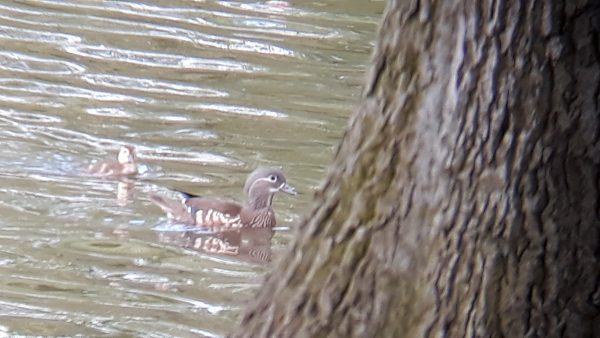 The Locko female and one of four ducklings The males in obvious competition but with no female in sight? The reason would become clear a few weeks later in early June when a female and four small young were sighted on the lake, she had likely already paired with one of the four males. A brilliant first breeding record for my local patch! Common Redstart
A jewel of a bird, the male a real cracker and the female an understated beauty. In my mind this species has come to represent the wonderful Derbyshire Dales and upland river valley’s just as much as the Dipper or Grey Wagtail. Arriving back from their African wintering grounds in April, I heard my first bird this year singing softly (the song – part finch, part warbler – once learned is not forgotten) from a thicket in Biggin Dale in Mid April. A week later along the fantastic Lathkill Dale, those singing males had really begun to show well. 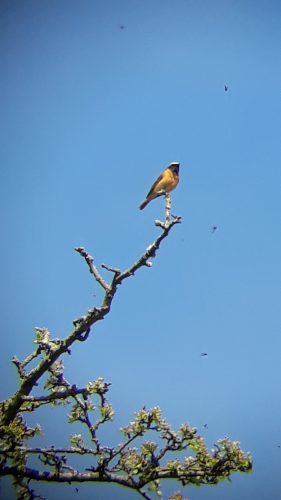 A male Redstart showing well Perched up in the small Hawthorns and Rowans that dot the open scrubby flanks of the upper part of this Dale. Singing, flycatching and chasing each other their red underparts contrasting with the black face/throat and grey crown, the small white patch on the forehead shining in the sun as the fiery orange tail (from which the bird gains it’s name) flicks restlessly. It was in Biggin Dale again that I saw my first female of the year. The warm brown bird with a beak full of nest material was having a set too with an aggressive little Blue Tit over a potential nest hole. Another female found sitting on a fence near the shore of Derwent Reservoir, was given the full treatment by a showy territorial male. Singing, tail flicking and strutting it’s stuff along the fence, it was clearly fancying it’s chances only for her to fly away and alight on a branch next to another singing male. Ouch!
More birds followed in the Dales, Moorland fringes and lower down the County around Middleton and Cromford. This striking migrant seems to be here in good numbers this year – learn the song and next time you are in the Peaks in Spring you stand a good chance of finding your own Redstart
Spotted Flycatcher
We have two species of breeding Flycatcher in the UK, the black and white Pied Flycatcher is a bird of upland woods and has its strongholds in the West of the UK but far more widely distributed is the once abundant Spotted Flycatcher. Once upon a time these upright, elegant, streaky brown birds were common in lots of habitats including mature gardens, but sadly it has experienced serious declines so now it has become a relatively scarce breeding bird in the County. The Pied Flycatcher arrives first and announces it’s presence in the woodland with a simple but fairly tuneful song – if the Pied Flycatchers song wouldn’t win any awards, the later arriving Spotted Flycatcher would struggle to release a record on its own independent label (though would have definitely enjoyed a Peel session or two!) – its song, best likened to a squeaky wheel is singularly unimpressive but it was this high pitch call that first grabbed my attention in a belt of Ashes in Biggin Dale in Mid May. 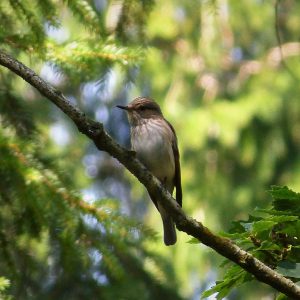 Forest of Dean Glos. 25 July 2017, Spotted Flycatcher (Muscicapa striata). gailhampshire from Cradley, Malvern, U.K As the birds appeared in the bare branches of the trees they allowed great views for the couple I was guiding on that day. Watching these graceful predators do their thing – sallying out from perches to snaffle up insects was a real treat. Fast forward a few days and the same call stopped me in my tracks in an urban park and I was delighted to watch a singing male, hunting just a couple of hundred metres from the City centre. My ‘Spotfly’ antenna seem to be working well by now so my next encounter was less of a suprise but just as welcome – two birds including a singing male on my local patch at Locko! At the time I write this they are still present and I have my fingers crossed for successful breeding.
|
|
|


